The GQ EMF-390 sits comfortably between entry-level meters and professional-grade equipment on price, and it packs in features you won’t find on most meters at any price. Data logging, RF spectrum analysis, a built-in alarm, and tri-field measurement capability in a single handheld device sounds almost too good to be true for the price.
Whether it actually delivers on those specs is a different question. You can check the current price of the GQ EMF-390 on Amazon before reading further.
This review covers what the EMF-390 measures well, where it struggles, and who it’s actually suited for.
What the GQ EMF-390 Measures
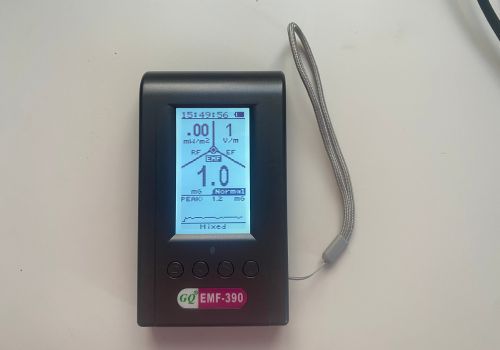
The EMF-390 handles all three major EMF types: AC magnetic fields, AC electric fields, and radio frequency radiation. That alone puts it ahead of budget meters that only detect magnetic fields or lack meaningful RF sensitivity.
Magnetic and Electric Field Performance
The magnetic field sensor operates in the standard range for consumer meters, measuring in milligauss (mG) or microtesla (μT) depending on your preference. In testing near common household sources like electrical panels, hair dryers, and running appliances, the EMF-390 produces readings broadly consistent with what you’d expect at this price point. Some independent testing suggests the magnetic sensor can read high at standard 60 Hz household frequencies, so treat absolute values with the usual consumer-grade caution and focus on relative comparisons rather than precise numbers.
The electric field mode, measured in volts per meter (V/m), is similarly reliable for home assessment purposes. It responds appropriately when you approach plugged-in but powered-off devices, and readings drop predictably when you increase distance from the source. Neither mode is going to match a professional Gigahertz Solutions meter for precision, but for identifying high-exposure areas and confirming that mitigation efforts are working, the accuracy is sufficient.
RF Detection and Spectrum Analysis
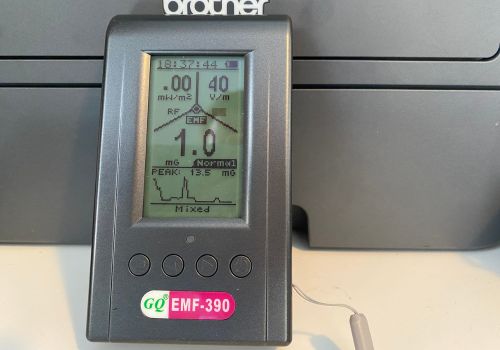
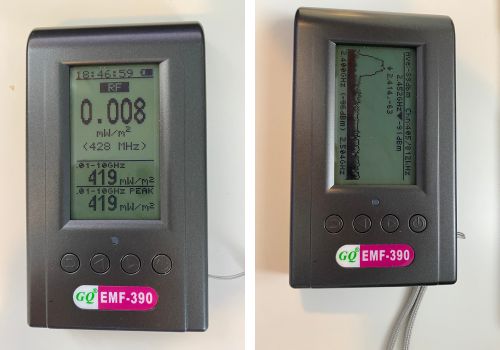
This is where the EMF-390 differentiates itself. Most consumer meters show a single RF reading; the EMF-390 includes a basic spectrum analyzer that displays signal strength across different frequency bands. You can see not just that RF is present, but which portion of the frequency spectrum is most active. For someone trying to identify whether a reading is coming from WiFi, a cellular signal, or a smart meter, that additional context is genuinely useful.
The RF detection range covers common frequencies including the 2.4 GHz and 5 GHz WiFi bands and standard cellular frequencies. One important caveat: like most consumer meters, the EMF-390 has limited sensitivity to 5G millimeter wave frequencies (above 24 GHz). If you live near millimeter wave 5G infrastructure, this meter won’t give you a complete picture of RF exposure from that source.
Data Logging: The Feature That Sets It Apart
The EMF-390’s most distinctive feature is its ability to record readings over time and transfer that data to a computer via USB. Most consumer meters require you to stand there taking notes by hand. The GQ EMF-390 stores a measurement history you can review later.
This turns out to be more useful than it might initially sound. RF radiation is variable and pulses in bursts rather than staying constant. A single snapshot reading tells you very little about actual exposure levels throughout the day. By logging continuously, you can identify patterns, like a smart meter that transmits several times per hour, or a neighbor’s WiFi router that spikes your readings at certain times. You can also use the data to compare before and after you implement mitigation strategies, which is much more convincing than relying on a single reading taken at one moment.
The companion software is functional but dated in its interface. It does the job of displaying logged data in a readable format, and you can export readings for your own analysis. Don’t expect a polished modern application, but the underlying data it captures is solid.
Build Quality and Usability
The EMF-390 is a larger meter than the TriField TF2, which some users appreciate (easier to handle, bigger display) and others find cumbersome. The LCD screen is readable in most lighting conditions, and the interface uses a combination of mode buttons to cycle between measurement types.
The built-in audible alarm can be set to trigger above a threshold you define. This is handy when walking through a space and wanting to be alerted to hotspots without constantly watching the screen. The alarm is adjustable in sensitivity, which prevents it from becoming an annoyance in higher-field environments where you just want to take measurements rather than hear constant beeping.
Battery life is a genuine strong point. GQ rates it up to 24 hours of continuous use, dropping to around 12 hours with the backlight on. For a full home walkthrough that’s far more than you’ll need, and the built-in rechargeable battery means no hunting for a 9V like you would with the TriField TF2.
Where the EMF-390 Falls Short
No meter at this price point is without trade-offs, and the EMF-390 has a few worth knowing before you buy.
RF Accuracy at the Frequency Extremes
Like most consumer RF meters, accuracy degrades somewhat at the low and high ends of its stated frequency range. Readings in the middle of the spectrum (the 900 MHz cellular and 2.4 GHz WiFi bands, for instance) are more reliable than readings at the outer edges. This is a common limitation in consumer meters and doesn’t make the EMF-390 unusual, but it’s worth understanding that the spectrum analyzer display is more useful for identifying which frequency bands are active than for precise power measurements.
The Interface Takes Getting Used To
Cycling through modes and accessing data logging functions involves a learning curve steeper than competitors like the TriField TF2. The manual explains the process clearly enough, but the button logic isn’t always intuitive, particularly when switching between peak and average measurement modes. Expect to spend some time with the documentation before you feel comfortable getting consistent, correctly configured readings.
RF Sensor Directionality
The magnetic field sensor is tri-axis, meaning it gives you an accurate composite reading regardless of how you hold the meter. The RF sensor is directional, so you’ll get the strongest readings by pointing the front of the meter toward the suspected source. If a reading seems lower than expected, rotating the meter 90 degrees along its length often resolves it.
This is worth knowing, but it’s not a knock specific to the EMF-390. Any consumer combination meter at this price point, including the TriField TF2, shares the same characteristic. If true tri-axis RF measurement is a priority, dedicated RF-only meters like the Acoustimeter handle it better, though you give up magnetic and electric field measurement in the process. For most home assessment purposes, the directional RF sensor on the EMF-390 is a minor adjustment to technique rather than a meaningful limitation.
Who Should Buy the GQ EMF-390
The EMF-390 makes the most sense for someone who wants more than basic detection but isn’t ready to spend on professional-grade equipment. The data logging feature alone makes it a strong value for anyone doing systematic home assessments, tracking changes over time, or monitoring exposure patterns in a bedroom or office, and it comes in at a lower price than the TriField TF2.
It’s also a reasonable choice for someone with a particular interest in RF analysis who wants to see frequency breakdown rather than just a single aggregated RF number. That spectrum view, while not professional-grade, offers more insight than any consumer meter at or near this price.
If you’re primarily concerned with magnetic fields from power lines or electrical infrastructure, the TriField TF2 is worth considering. Its magnetic field accuracy at 60 Hz is among the best at this price point, and the interface is considerably simpler to use. It will cost you a bit more, but for magnetic field assessment specifically, that trade-off may be worth it. On the other hand, if RF monitoring, data logging, and broader feature set are priorities, the GQ EMF-390 earns its place.
Frequently Asked Questions
These are the questions that come up most often from people considering the EMF-390 for home use.
Can the GQ EMF-390 detect 5G?
The EMF-390 detects the sub-6 GHz frequencies used by most 5G networks currently in service, including the bands used for 5G on existing cellular infrastructure. It has limited sensitivity to millimeter wave 5G (24 GHz and above), which remains less common in residential areas. For most home assessments, this limitation is unlikely to matter significantly.
How does the EMF-390 compare to the TriField TF2?
Both meters measure all three EMF types at similar accuracy levels. The EMF-390 adds data logging and basic RF spectrum analysis; the TriField TF2 offers a simpler interface and a more reliably calibrated magnetic field sensor at 60 Hz specifically. If data logging matters to you, the EMF-390 is worth checking out on Amazon. If you want the most straightforward measurement experience, the TF2 has the edge.
Is the data logging actually useful for home assessment?
For most home assessment goals, yes. It’s particularly valuable for RF measurements, since wireless signals vary considerably throughout the day. Logging lets you capture peak exposure levels you’d miss with spot readings. For identifying whether your bedroom has elevated fields during sleeping hours without standing there all night, it’s a practical tool.
Does the EMF-390 need calibration?
Like all consumer meters, the EMF-390 will drift over time. GQ recommends factory calibration periodically, though the meter cannot be user-recalibrated. For home assessment purposes, annual calibration is reasonable if you’re making significant decisions based on the readings. For general monitoring and comparative measurements, most users find the meter remains consistent enough for several years of normal use.
Is the EMF-390 accurate enough to compare against Building Biology standards?
Consumer meters, including the EMF-390, have accuracy tolerances (typically ±20-30%) that make them less reliable for precise compliance testing against specific threshold values. The EMF-390 is well-suited to identifying elevated areas, tracking changes, and making relative comparisons. For documentation purposes or formal assessment against specific standards, professional-grade equipment or a certified EMF consultant provides more defensible data. If you’re at the research stage and want to see current pricing and reviews, the EMF-390 listing on Amazon is a good place to start.