You’ve purchased an EMF meter, taken your readings, and now you’re wondering: can I actually trust these numbers? Are consumer-grade meters accurate enough to make decisions about your home’s EMF exposure?
This is a legitimate concern. EMF meters range in price from $30 to over $10,000, and accuracy varies significantly across this spectrum. Understanding what level of accuracy you can expect from consumer-grade equipment helps you interpret your readings appropriately and know when you might need professional-grade equipment.
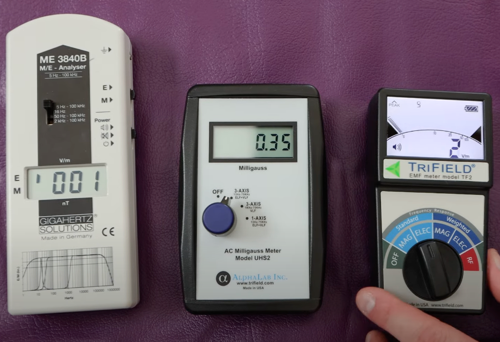
If you’re looking for reliable consumer meters that balance accuracy with affordability, check out our EMF meter comparison and reviews.
What “Accuracy” Actually Means
When EMF meter manufacturers specify accuracy, they typically express it as a percentage or tolerance range. For example, a meter with ±20% accuracy showing a reading of 10 mG could actually be measuring anywhere from 8 to 12 mG.
However, accuracy in EMF meters involves more than just this tolerance:
Frequency response: How accurately the meter measures across different frequencies within its range. A meter might be highly accurate at 60 Hz but less accurate at 180 Hz or higher harmonics.
Sensor quality: Higher quality sensors maintain accuracy across a wider range of field strengths and environmental conditions.
Measurement consistency: Whether the meter produces repeatable results when measuring the same source multiple times under the same conditions.
Factory calibration: How precisely the meter was calibrated during manufacturing and how well it holds that calibration over time.
Consumer-Grade vs. Professional-Grade Accuracy
Here’s what you can realistically expect from meters at different price points.
Consumer-Grade Meters ($30 to $500)
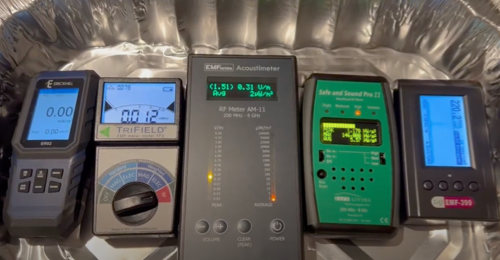
Consumer-grade meters typically offer accuracy in the range of ±10% to ±30%, depending on the specific meter and what type of field it’s measuring. Popular models like the TriField TF2 and GQ EMF-390 fall into this category.
Typical accuracy levels:
Magnetic fields: ±15% to ±25% Electric fields: ±20% to ±30% RF radiation: ±20% to ±35%
What this means in practice: If your meter shows 5 mG, the actual reading could be anywhere from about 3.75 to 6.25 mG with ±25% accuracy. For home use, this level of precision is usually sufficient to identify problem areas and verify that changes you make are actually reducing exposure.
Professional-Grade Meters ($500 to $2,000)
Professional meters like those from Gigahertz Solutions or the Safe and Sound Pro II offer better accuracy, typically in the ±3% to ±10% range. These meters also tend to have wider frequency ranges and more sensitive detection thresholds.
EMF consultants, building biologists, and researchers use these meters when precise measurements matter for professional assessments or when documenting levels for clients.
Laboratory-Grade Equipment ($2,000 to $10,000+)
Laboratory instruments used for research, regulatory compliance testing, and industrial applications offer the highest accuracy, often ±1% to ±3%. These require controlled environments, trained operators, and regular professional calibration to maintain their specifications. Most homeowners have no need for this level of precision.
Factors That Affect Consumer Meter Accuracy
Several factors beyond the meter’s base specifications influence the accuracy of your readings.
Sensor Type and Quality
Single-axis meters require you to rotate the device to find the maximum reading. User error in positioning introduces variability, even if the sensor itself is accurate. You might get different readings simply by holding the meter at slightly different angles.
Tri-axis meters measure from all three directions simultaneously and calculate the total field strength automatically. This eliminates positioning error and provides more consistent results. The TriField TF2 uses a true 3-axis sensor for magnetic fields, which is one reason it’s popular despite its moderate price.
Frequency Range Limitations
Many consumer meters are optimized for power-line frequencies (50-60 Hz) but become less accurate at higher frequencies within their stated range.
For example, a meter might accurately measure your electrical panel (60 Hz) but give less reliable readings for switching power supplies, variable speed motors, or other sources that operate at higher frequencies. If you’re concerned about specific frequency ranges, check the meter’s specifications to see where its accuracy is best.
Environmental Factors
Temperature extremes can affect sensor performance. Most consumer meters are specified for use between about 32°F and 104°F (0°C to 40°C). Using a meter outside this range may produce less accurate readings.
Strong electromagnetic fields from nearby sources can sometimes interfere with measurements, causing unstable readings or values that don’t settle properly.
How Meters Maintain Calibration
Quality consumer meters like the TriField TF2 and GQ EMF-390 are factory calibrated during manufacturing and designed to hold that calibration over years of normal use. Unlike professional laboratory equipment that requires annual recalibration by certified technicians, consumer meters are not designed for user recalibration or routine calibration services.
This doesn’t mean they become inaccurate quickly. Reputable manufacturers like AlphaLab (maker of the TriField) design their meters with stable components that maintain calibration well over time under normal use conditions. The TriField TF2, for instance, uses quality sensors specifically chosen for long-term stability.
If a consumer meter does drift significantly over time or after being dropped or exposed to extreme conditions, replacement is typically the practical solution rather than recalibration.
How Accurate Do You Really Need?
The answer depends entirely on what you’re trying to accomplish.
For Basic Home Assessment
If your goal is to identify high-EMF areas in your home and verify that mitigation efforts reduce exposure, consumer-grade accuracy works well.
You don’t need to know if a reading is exactly 2.3 mG or 2.7 mG. What matters is:
Identifying that one area measures significantly higher than another
Confirming that readings drop when you turn off a device or increase distance
Verifying that shielding or other interventions actually reduce measured levels
Tracking whether readings in a particular location change over time
A meter with ±20% to ±25% accuracy handles all of these tasks effectively because you’re looking at relative differences and trends, not absolute precision.
When Higher Accuracy Matters
Consider investing in professional-grade meters if you:
Are creating a low-EMF environment for someone with electromagnetic hypersensitivity who needs to verify very low levels
Need to document EMF levels for legal, medical, or real estate purposes
Work as an EMF consultant and provide measurements to clients
Want to verify compliance with specific building biology guidelines like the SBM-2015 standards from the Building Biology Institute
Need to test shielding effectiveness with precise before and after measurements
When Budget Meters Fall Short
Very inexpensive meters (under $50) often have accuracy and reliability issues that limit their usefulness:
Inconsistent readings from the same source measured multiple times
Extreme sensitivity to how you hold or position the meter
Poor frequency response that misses important signals
Inability to distinguish between field types properly
Sensors that drift or fail relatively quickly
If you’re serious about understanding your EMF environment, investing $150 to $300 in a reputable meter provides significantly better accuracy and reliability than ultra-cheap alternatives.
Comparing Popular Consumer Meters
Here’s how some widely used meters compare in terms of accuracy and reliability.
TriField TF2 (approximately $170)
The TriField TF2 is considered the best balance of accuracy, features, and price for consumer use. It measures all three EMF types (magnetic, electric, and RF) with reasonable accuracy and uses a true 3-axis sensor for magnetic field measurements.
AlphaLab, the manufacturer, has been making EMF meters since 1993 and the TF2 benefits from decades of refinement. It’s known for holding calibration well and producing consistent, repeatable measurements.
GQ EMF-390 (approximately $180)
The GQ EMF-390 offers similar capabilities to the TriField TF2 with added features like data logging, RF spectrum analysis, and PC connectivity. It measures magnetic fields, electric fields, and RF radiation.
The data logging feature is particularly useful because it lets you record measurements over time, which helps compensate for any single-reading variability and shows patterns you might miss with spot measurements.
Safe and Sound Pro II (approximately $400)
This specialized RF meter focuses exclusively on radio frequency measurements but does so with professional-grade accuracy. It’s more expensive than combination meters but provides significantly better precision for RF detection.
If wireless radiation from cell towers, WiFi, smart meters, or 5G is your primary concern, the improved accuracy and sensitivity may justify the higher cost.
Budget Options ($30 to $100)
Meters in this range typically measure only magnetic and electric fields (no RF capability) with accuracy around ±30% to ±50%. They can detect obvious high-exposure areas but aren’t ideal for precise measurements or subtle differences.
They’re acceptable as a starting point to see if EMF is even a concern in your environment, but most people who get serious about EMF assessment eventually upgrade to a better meter.
Maximizing Accuracy with Any Meter
Even a moderately accurate meter gives you reliable, useful results if you use proper technique.
Take Multiple Measurements
Don’t rely on a single reading. Take 3 to 5 measurements at each location you’re assessing and note the range. If readings are consistent, you can trust the average. If they vary widely, something may be interfering or the field itself may be fluctuating.
Allow Readings to Stabilize
After positioning your meter, wait 3 to 5 seconds before recording the measurement. Rushed readings often capture transient values rather than the actual steady-state field level.
Maintain Consistent Technique
When comparing readings between different locations or before and after making changes, hold the meter the same way, at the same height, and oriented the same direction each time. Consistency in technique improves the reliability of comparisons even if absolute accuracy is imperfect.
Understand What You’re Measuring
Know which mode your meter is in and what it’s actually detecting. The “RF” mode on most consumer meters doesn’t detect all wireless frequencies, particularly newer high-band 5G signals. The magnetic field mode may not accurately capture higher-frequency harmonics from certain electronic devices.
Reading your meter’s manual helps you understand its capabilities and limitations for the specific sources you want to measure.
Document Your Methodology
Keep notes on how you took measurements: what mode, what height, what distance from sources, what time of day. This lets you replicate your methodology later and makes your measurements more meaningful over time.
Understanding Meter Specifications
Manufacturer specifications can be confusing. Here’s how to interpret the numbers you see on spec sheets.
Accuracy vs. Resolution
Resolution is how finely the meter can display readings (for example, 0.1 mG increments). Accuracy is how close those readings are to the true value. A meter might display readings to 0.1 mG precision but only be accurate to ±1 mG. Don’t confuse detailed displays with actual accuracy.
Frequency Range
A meter listing “20 MHz to 6 GHz” for RF measurements will typically be most accurate in the middle of this range and less accurate at the extremes. The stated range tells you what the meter can detect, not necessarily where it’s most accurate.
Sensitivity vs. Accuracy
Sensitivity is the lowest level a meter can detect. A highly sensitive meter can pick up very weak fields but might not measure them accurately. Conversely, a less sensitive meter might give accurate readings for the fields it can detect while missing weaker signals entirely.
Frequently Asked Questions
Is a $50 EMF meter accurate enough for home use?
Budget meters in the $30 to $100 range typically have ±30% to ±50% accuracy and often lack RF measurement capability. They can identify obvious high-exposure areas but aren’t reliable for precise measurements or subtle differences. For comprehensive home assessment, spending $150 to $200 on a quality meter like the TriField TF2 provides significantly better accuracy and measures all three field types.
Do EMF meters need to be recalibrated?
Consumer meters like the TriField TF2 and GQ EMF-390 are factory calibrated and designed to maintain that calibration over years of normal use. Unlike professional laboratory equipment, these meters are not designed for user recalibration or routine calibration services. Quality consumer meters use stable components specifically chosen to hold calibration long-term. If accuracy degrades significantly due to age, damage, or extreme conditions, replacement is typically the practical option.
Can I trust readings that vary between different meters?
Some variation between meters is normal, especially when comparing different brands or price levels. Differences of 10% to 30% measuring the same source are common for consumer-grade equipment. Larger discrepancies suggest one meter may be malfunctioning or measuring a different aspect of the field. Focus on trends and relative differences rather than expecting identical absolute values from different meters.
Do readings change at different times of day?
Yes, particularly for magnetic fields from electrical systems. Readings change based on how much current is flowing, which varies with power usage throughout the day. You might measure higher magnetic fields near your electrical panel in the evening when more lights and appliances are running. Electric fields stay more stable since they depend on voltage rather than current. RF levels can vary significantly based on wireless device activity, cell tower traffic, and your neighbors’ usage patterns.
How do I know if my EMF meter is working correctly?
Test your meter against known sources to verify it’s responding properly. For magnetic fields, measure near a running hair dryer, electric motor, or vacuum cleaner and verify readings increase as you get closer and decrease as you move away. For RF, test near an active cell phone or WiFi router. Readings should respond predictably to distance and should be reasonably consistent when measuring the same source multiple times under identical conditions. If readings are erratic, don’t respond to known sources, or vary wildly between repeated measurements, the meter may need replacement.
Are smartphone EMF apps accurate?
No. Smartphone apps that claim to measure EMF can only access the phone’s built-in magnetometer, which detects static magnetic fields like Earth’s magnetic field. They cannot measure the AC magnetic fields from your electrical system, electric fields, or RF radiation from wireless sources. These apps are essentially useless for meaningful EMF assessment compared to dedicated meters with proper sensors.
The Bottom Line on Consumer Meter Accuracy
Consumer-grade EMF meters provide a practical balance between accuracy, functionality, and affordability. While they don’t match professional equipment, their accuracy is more than sufficient for the vast majority of home assessment needs.
A $170 TriField TF2 used with proper technique will give you far more useful information than a $2,000 professional meter used carelessly. The key is understanding your meter’s limitations and using consistent methodology.
For identifying problem areas in your home, verifying that mitigation efforts work, and tracking changes over time, consumer meters with ±20% to ±25% accuracy do the job well. Focus on patterns, relative differences, and trends rather than obsessing over exact numbers.
If you need precise measurements for professional documentation, medical purposes, or compliance verification, consider either investing in professional equipment or hiring a qualified EMF consultant who has properly maintained laboratory-grade meters and the expertise to use them correctly.